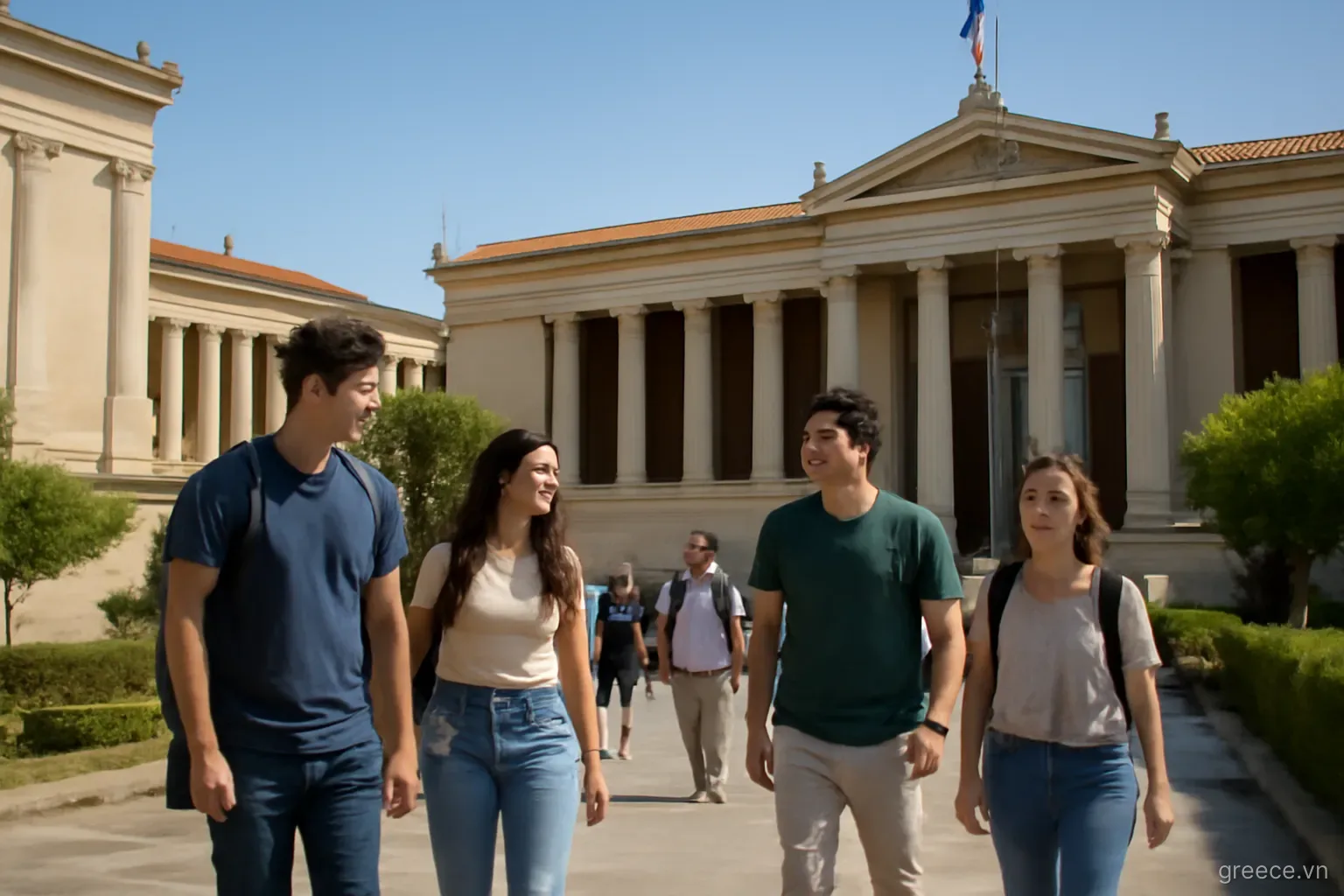
Clear budgeting is the first step when planning to study in Greece.
- The official language is Greek, while English is widely spoken in tourism and larger cities.
- Greece counts more than 6,000 islands and islets, of which roughly 200 are inhabited.
- It has a Mediterranean climate with hot, dry summers and mild, sunny winters.
Leading universities include the National and Kapodistrian University of Athens and Aristotle University of Thessaloniki.
Many postgraduate programmes are taught in English, drawing international students.
Tuition by level
Student living costs in Greece are among the more affordable in the EU.
International students may work part-time within the hours set by their study visa.
Greek degrees are recognised across the EU under the Bologna Process.
Living expenses
The Vietnamese community is small but present in Athens.
Opening a bank account requires a passport, tax number and residence documents.
Summers can be very hot, so choose a home with air-conditioning and near the sea if possible.
Scholarships and aid
Strong fields include maritime studies, archaeology, tourism-hospitality and medicine.
- Greece's education system spans schooling, low-fee public universities and many international programmes.
- Public-university tuition for non-EU students is far lower than in Western Europe or the US.
- Scholarships come from the Greek state, the EU's Erasmus+ and individual universities.
- Greece lies in Southeastern Europe at the southern tip of the Balkan Peninsula on the Mediterranean.
- The capital, Athens, is the political and economic hub and the birthplace of Western democracy.
Working while studying
Greece owns one of the world's largest merchant fleets by tonnage.
Tourism contributes a sizeable share of GDP, welcoming tens of millions of visitors yearly.
After the 2010s debt crisis, the economy has recovered and returned to growth.
Total yearly budget
Residence holders must register a tax number (AFM) and a social-security number.
Public transport in Athens includes a convenient metro, buses and trams.
Fresh food, sunny weather and a relaxed pace are big pluses.
Need a tailored roadmap?
Viking Global Group walks with you from paperwork to settlement. Call +849.219.219.88 or email [email protected] for a free consultation.
Related articles
- Housing in Greece: rent or buy, and where
- Life in Greece: pace, income and social welfare
- Study Abroad
Frequently asked questions
How much does tuition cost in Greece?
Public undergraduate programmes are generally free for EU students, while non-EU students may pay fees, and many master's and English-taught programmes charge tuition. Amounts vary by institution and programme, so check each university's official information.
What living costs should students plan for?
Rent or dormitory fees, food, transport, phone, health insurance, books and personal expenses. Athens is usually more expensive than other university cities such as Thessaloniki, Patras or Heraklion. Rents have risen in recent years, so housing should be arranged early.
Are scholarships available for international students?
Some scholarships come from the Greek state, private foundations, EU exchange programmes and individual universities, particularly for master's study. Competition is strong, so applicants need strong academic records and must meet deadlines.
Can students work part time?
Non-EU students with a study residence permit can usually work part time within legal limits. Most jobs are in tourism, hospitality or tutoring and often require Greek. Students should not rely on part-time income to cover tuition.
How can students build a realistic budget?
Add up programme tuition, city-specific living costs, insurance, flights, visa and document fees and an emergency fund. The minimum funds required by the immigration authorities are a useful baseline, adjusted upward for your actual lifestyle.
Information is for reference and may change under the latest official policy. Please contact us for current regulations.